
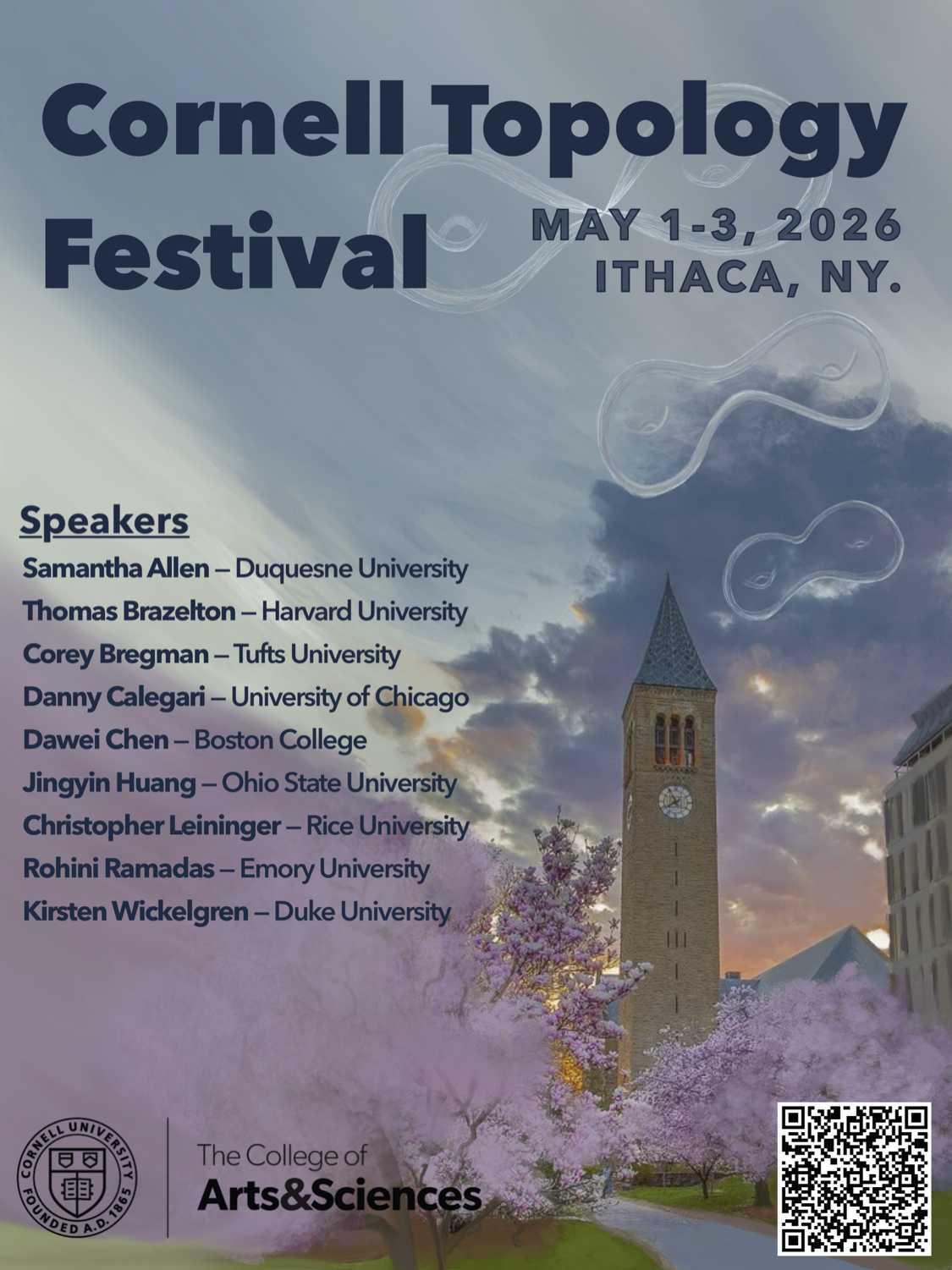
Schedule, 2026
Lectures will be all in Malott 251 – Campus Map. Plenary talks are scheduled for 50 minutes plus 10 minutes for questions. Breakfasts, lunches, coffee etc. will be provided (t.b.c.!) in the Malott Hall fifth floor lounge (MLT 532). All times are ET.
Friday, 1 May 2026
| —— Check-in, Malott Hall fifth floor lounge from 10:30 —— | |
| 10:45–11:15 | Ino Loukidou
Introductory talk: The Cannon–Thurston map ▾
In the 80's, while studying hyperbolic structures on surface bundles over the circle, Thurston ran into the following peculiar phenomenon: In the universal cover H^3, any lift of the universal cover of a fiber must accumulate to the whole boundary S^2. This of course would imply that if the inclusion could be extended to a continuous map of the boundaries S^1 -> S^2 it would have to be surjective - a sphere filling circle. It turns out that the inclusion indeed extends and in this introductory talk we will explain the original construction due to Cannon and Thurston and give some basic properties of the map.
|
| 11:20–11:50 | Junmo Ryang
Introductory talk: An introduction to convex cocompact subgroups of mapping class groups ▾
In 2002, Farb and Mosher introduced the notion of convex cocompact subgroups of mapping class groups to capture coarse geometric information of their associated surface group extensions and surface bundles. The success of their theory indicates that convex cocompactness should feature prominently in the study of (coarse) hyperbolic surface bundles. We give a gentle introduction to this perspective first through the familiar lens of surface bundles over circles, then discuss what is known when we modify the base space.
|
| —— Lunch —— | |
| 1:20–1:50 | Juliet Aygun
Introductory talk: Strata of translation surfaces
▾ Given a Riemann surface X, we can equip it with a holomorphic differential w. The pair (X,w) is called a translation surface. Translation surfaces are equivalent to a collection of polygons in the complex plane with sides identified pairwise by translation (defined up to cut-and-paste operations). This induces a flat cone metric on X, and the singularities of w coincide with the cone points of (X,w). A stratum is the space of all translation surfaces with a prescribed number of cone points and list of cone point angles. In this introductory talk, we will study examples of translation surfaces and describe properties of strata such as their local coordinates, their components, and their natural GL(2,R) action. |
| 1:55–2:25 | Alberto Landi
Introductory talk: Monodromy Groups of Enumerative Problems
▾ An enumerative problem naturally induces a generically finite and generically étale cover $Y \rightarrow X$, where $Y$ is the moduli space of solutions and $X$ is the moduli space of geometric conditions. The degree of this map gives the classical solution count, but the deeper structural relationships between these solutions are controlled by the cover’s monodromy (or Galois) group. In particular, it determines whether the equations defining the solutions can be explicitly written down and solved by radicals in terms of the base parameters. In this talk, I will introduce monodromy groups in enumerative geometry, explaining how they are defined and why they are essential for understanding the intrinsic geometry and splitting behavior of these problems. I will present several illustrative examples and conclude by outlining how upgrading our moduli spaces from schemes to stacks serves as a valuable tool for studying monodromy problems. |
| 2:30–3:00 | Darragh Glynn
Introductory talk: Moduli of Riemann surfaces: degenerations, compactifications and stratifications
▾ The moduli space M_{g,n} parametrises genus-g, n-marked Riemann surfaces. It is not compact, but by allowing degenerate nodal Riemann surfaces — obtained by pinching loops to nodes — we obtain the Deligne-Mumford compactification. The compactification decomposes into strata corresponding to the different combinatorial types of degenerations. We present this story from a topological perspective, and explain how it lifts to the universal cover of M_{g,n}, the Teichmüller space T_{g,n}, resulting in the augmented Teichmüller space introduced by Bers. |
| —— Break —— | |
| 4:00–5:00 | Chris Leininger, Plenary talk — Joint meeting with the Oliver Club
Surface bundles and hyperbolic geometry
▾
In the 1970s and 1980s, W. Thurston's seminal work on mapping class groups and hyperbolization of surface bundles over the circle inspired numerous research directions. In particular, in the 1990s the following problem started gaining considerable attention: Can one construct hyperbolic surface bundles over surfaces? Such surface bundles are atoroidal, and this led to a follow up: Can one construct atoroidal surface bundles over surfaces? In this talk I'll recall Thurston's work, provide a general discussion of surface bundles and mapping class groups, describe the evolution of the questions above, and discuss my work with Autumn Kent producing infinitely many atoroidal surface bundles, "many" of which fail to be hyperbolic manifolds.
|
Saturday, 2 May 2026
| —— Breakfast from 8:30 —— | |
| 9:00–10:00 | Danny Calegari
Plenary talk: A tale of two Cannons
▾
What do Cannon–Thurston maps and the Cannon conjecture have to do with each other? Come to the talk and find out! Along the way I’ll present a unified theory of pseudo-Anosov flows, CaTherine wheels, Zippers, and uniform quasimorphisms; and sketch the faintest outline of a program to attack the Cannon conjecture.
|
| 10:10–11:10 | Corey Bregman
Plenary talk: The prime decomposition fiber sequence of a reducible 3-manifold
▾ Geometrization is a powerful principle which has shaped our understanding of irreducible 3-manifolds and, more recently, the structure of their diffeomorphism groups. However, diffeomorphism groups of reducible 3-manifolds remain somewhat elusive. Inspired by an approach of Hatcher, we construct a “splitting map” from the classifying space of the diffeomorphism group of a reducible 3-manifold to that of its irreducible prime factors. This results in a “prime decomposition fiber sequence” whose fiber we describe explicitly as a homotopy colimit over a finite category of graphs. We also develop a framework for computation, which we apply to calculate the rational cohomology ring of the classifying space in specific examples. This is joint work with Rachael Boyd and Jan Steinebrunner. |
| —— Coffee —— | |
| 11:40–12:40 | Dawei Chen
Plenary talk: Topology of moduli spaces of differentials
▾
Differentials on Riemann surfaces correspond to translation surfaces with conical singularities, and affine transformations of these surfaces preserve the orders of the singularities. This viewpoint allows moduli spaces of differentials to appear in many different guises across several areas of mathematics. Over the past few decades, remarkable progress has been made in computing invariants of these moduli spaces, classifying linear subvarieties, understanding degenerations and compactifications, and developing intersection theory on them. Despite these advances, our understanding of the topology of moduli spaces of differentials remains limited, and many fundamental questions are still open. In this talk, I will present, from an algebro-geometric perspective, some known results and open problems concerning the topology of moduli spaces of differentials, together with their connections to other aspects of the subject.
|
| —— Lunch —— | |
| 1:40–2:40 | Samantha Allen
Plenary talk: Knot primality using classical and Floer-theoretic methods
▾
The main tools for proving that a knot is prime have historically been geometric, depending on hyperbolic geometry, incompressible surfaces, or geometric decompositions of the knot complement. In prior work joint with Livingston, Temkin, and Wong, we use the two-variable knot Floer polynomial to develop algebraic strategies for proving primality of knots. Our computer implementation of these strategies efficiently proves primality for over 92% of prime knots up to 15 crossings. In recent work with Livingston, we additionally leverage classical knot-theoretic methods: cyclic, dihedral, and metacyclic covering spaces. Collectively, after implementation, these primality tests have proved primality for over 99.6% of knots in large families, including all prime knots with 15 or fewer crossings.
In this talk, I will give a brief overview of the history of knot primality, and discuss the advances in Heegaard Floer theory which underpin our work and make it possible to efficiently implement our algorithms. If time permits, I will explore how the additional use of covering spaces works in tandem with the knot Floer polynomial to create a more effective strategy.
|
| —— Break —— | |
| 3:10–4:40 | Panel discussion |
| —— Picnic at Myers Park, Pavilion F in Lansing from 5:30 —— | |
Sunday, 3 May 2026
| —— Breakfast from 8:30 —— | |
| 9:00–10:00 | Kirsten Wickelgren
Plenary talk: Gromov–Witten invariants in Hermitian K-theory
▾ Quadratic Gromov--Witten invariants allow one to obtain an arithmetically meaningful count of genus 0 curves satisfying constraints over a field k without assuming that k is the field of complex or real numbers. They were developed in joint work with Kass, Levine, and Solomon. They take values in the Hermitian K-theory of k. In this talk we will compute structures on these invariants, which for example compute all the invariants for the projective plane. This is joint work with Erwan Brugallé and Johannes Rau.
|
| 10:10–11:10 | Thomas Brazelton
Plenary talk: Symmetry and solvability in enumerative geometry
▾
A large problem in 19th century mathematics was to determine when the solutions to certain problems were solvable (in radicals) in terms of their parameters. Just as finding a root of a quintic in terms of the coefficients of the quintic is unsolvable, there exist classical geometry problems which are unsolvable as well, for instance solving for the equations of the 27 lines on a cubic surface in terms of the coefficients defining the cubic surface. We prove that if a smooth complex cubic surface has any symmetry whatsoever, there exist formulas in radicals for its lines. We will provide an overview of the tools used to attack this and similar problems, drawing from equivariant homotopy theory, Hodge theory and hyperbolic geometry, stacks, and numerical algebraic geometry. This is joint work with A. Landi and S. Raman.
|
| —— Coffee —— | |
| 11:40–12:40 | Rohini Ramadas
Plenary talk: Outer Space, Handlebodies, and Tropical Moduli Spaces
▾ The moduli space M_{g,n}^{trop} of metric graphs is a polyhedral object. It is “the tropicalization of” the moduli space M_{g,n} of Riemann surfaces, as I will explain. Teichmuller space T_{g,n} is the space of Riemann surfaces together with a topological marking. It is the universal cover of M_{g,n}. Culler-Vogmann Outer space CV_{g,n} is the space of metric graphs together with a topological marking, and lives over M_{g,n}^{trop}. I will discuss the extent to which “tropicalization” makes sense in the context of spaces like T_{g,n} and CV_{g,n}. This talk is based on joint work with Rob Silversmith, Karen Vogtmann, and Rebecca Winarski. |
| —— Lunch — Students & Speakers Luncheon in the Physical Sciences Building (Baker Portico) — For those who did not indicate they will be attending the graduate lunch in their registration, there will be pizza in 532 Malott Hall —— | |
| 2:00–3:00 | Jingyin Huang
Plenary talk: Exotic aspherical 4-manifolds
▾
We show that there are closed, aspherical, smooth 4-manifolds that are homeomorphic but not diffeomorphic. This is joint work with Davis, Hayden, Ruberman, and Sunukjian.
|
| —— Break —— | |
| 3:30–4:30 | Christopher Leininger,
Plenary talk: Atoroidal surface bundles
▾ I'll sketch the proof of the theorem with Kent on the existence of atoroidal surface bundles over surfaces, and if there is time, describe our conjecture regarding the coarse geometry of such bundles. |